
TT or TL- tube type or tubeless tyres
Air Provides Load Capacity
The tyre is the only contact between the vehicle and the road surface and therefore has a major influence on driving behaviour, handling, and safety. Tyres are developed with attention to the surface, the load, and the temperature generated during use. The rubber compound and tread are carefully tailored to this.
The air pressure in a tyre provides approximately 90% of the total load capacity. The tyre construction itself absorbs the remaining load. Correct tyre pressure is therefore essential, regardless of whether you choose a TT or TL tyre.
What is a Tubeless Tyre?
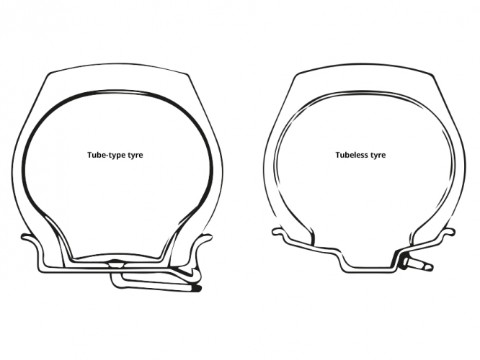
A tubeless tyre (TL) is a tyre without an inner tube that seals airtight directly onto a special tubeless rim with a raised edge, also known as the hump. The valve is located directly in the rim and is equipped with a rubber seal.
The tyre is constructed in such a way that the carcass and rubber compound allow minimal air permeability. As a result, the tyre maintains pressure for a long time without an inner tube.
Tubeless Tyres (TL)
A key advantage of a tubeless tyre is its behaviour in case of a puncture. When a puncture occurs in the tread—for example due to a nail—a tubeless tyre deflates gradually. This ensures that the vehicle remains more controllable and that handling does not decrease abruptly, increasing safety.
Repair of a tubeless tyre is often possible:
-
small damages can be repaired with a repair patch on the inside
-
larger damages can be repaired by means of vulcanisation
Tyres with Inner Tube (TT)
The tyre with inner tube (TT) is the more traditional solution. A separate inner tube with its own valve is mounted inside the outer tyre. The size of the inner tube must exactly match the tyre size.
A tube that is too large can fold and fail prematurely.
A tube that is too small will be overstretched, leading to increased wear, friction, and poorer sealing.
An advantage of TT tyres is that in the event of a puncture, often only the inner tube needs to be replaced, which in some cases is cheaper than replacing a complete tubeless tyre.
TT versus TL: Key Points of Attention
The choice between a TT or TL tyre depends on the rim construction, the vehicle type, and the application. While a tubeless tyre reacts more safely in case of a puncture, a tube type tyre may be preferred in specific applications or with older rims.
Risks and points of attention when using an inner tube:
-
incorrect sizing between tyre, inner tube, and rim
-
additional friction between inner and outer tyre, resulting in heat build-up
-
sudden deflation in case of a puncture
-
risk of a bulging inner tube in case of damage to the outer tyre
-
correct use of a rim tape to protect against sharp edges and irregularities