
What is the optimal tyre pressure for agricultural tyres?
Incorrect pressure — either too high or too low — increases the risk of tyre damage and reduces overall performance.
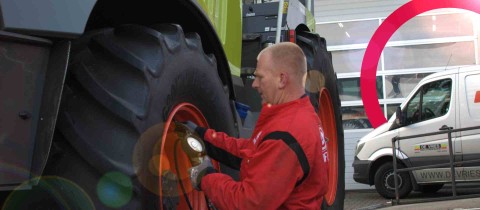
Tyre Pressure for Agricultural Vehicles
One of the biggest challenges is operating with mounted or trailed implements. Additional weight behind the tractor’s centre of gravity creates a lever effect and load transfer between axles.
Example:
With a plough, there is a significant difference between field position (working horizontally) and transport position (folded and raised). In transport mode, both load and speed increase, placing more stress on the rear axle while unloading the front axle.
Adjusting tyre pressure when using implements
Regardless of the implement type, tyre pressure should always be matched to the highest load condition.
In some cases, this would mean nearly doubling the pressure in the rear tyres — which is not practical for field work. Therefore, it is essential to adjust tyre pressure when switching between field and road use.
If frequent adjustment is not practical, consider using tyres with a larger air volume and the same rolling circumference. However, this is not always possible due to implement width or machine limitations.
Wheel load and speed determine the pressure
The correct tyre pressure is influenced by two key factors:
- Wheel load – calculated theoretically or measured
- Speed – higher speeds require higher pressure
Always use the manufacturer’s tyre pressure tables, as values differ per brand and tyre construction.
Tyre pressure table for agricultural tyres
A standard agricultural tyre balances load capacity (kg), speed (km/h) and inflation pressure (bar).
If one factor changes — for example higher speed — the tyre pressure must also be adjusted accordingly.
Load capacity (kg) at tyre pressure (bar)
| KM/h | 1 bar | 1.3 bar | 1.6 bar | 2 bar |
|---|---|---|---|---|
| 10 | 4820 | 5680 | 6430 | 7180 |
| 15 | 4500 | 5300 | 6000 | 6700 |
| 20 | 4500 | 5300 | 6000 | 6700 |
| 65 | 4500 | 5300 | 6000 | 6700 |
| 70 | 4100 | 4820 | 5460 | 6100 |
Prevent unnecessary wear
Incorrect tyre pressure can lead to:
- excessive flexing and heat build-up
- sidewall damage
- loss of traction due to tyre slip on the rim
- accelerated tread and carcass wear
Central tyre inflation systems (CTIS)
With a central tyre inflation system, you can always operate at the optimal pressure.
On the road, you use higher pressure for stability and efficiency. In the field, you lower the pressure to increase the footprint and reduce soil compaction.
This system is particularly beneficial for:
- self-propelled harvesters
- slurry tankers
- heavy tractors with trailers
Benefits of CTIS:
- Fuel savings in the field: 7%–10%
- Fuel savings on the road:
- tractor only: ~5%
- with implement: ~12%
- with trailer: ~17%
- Up to 30% less tyre wear
- Reduced soil compaction and improved crop yield
IF and VF tyres on narrower rims
IF (Increased Flexion) and VF (Very High Flexion) tyres are often designed for wider rims to maintain air volume and stability.
Thanks to the Narrow Rim Option (NRO), some tyre models can also be fitted on narrower rims.
Note: This is not available for every brand or size and may require higher inflation pressure.
Frequently asked questions about agricultural tyre pressure
What is the optimal tyre pressure for a tractor on the road?
Tyre pressure should always match the highest load and speed. Consult the manufacturer’s pressure tables for exact values.
Should I adjust tyre pressure between field and road?
Yes. Lower pressure is ideal for fieldwork (traction and soil protection), while higher pressure is required for road transport (stability and safety).
How can I easily adjust tyre pressure?
With a central tyre inflation system (CTIS), you can switch between pressures while driving, depending on the surface.
Why do tyre pressure tables differ by brand?
Each manufacturer uses different tyre constructions and materials, which results in different pressure/load values. Always use brand-specific data.